


SWOT isn't dead. But a four-box analysis is no longer sufficient to grasp the complexity of the world.


For years, I've been seeing the same scene in strategy discussions. A management team gets together. Four large boxes are drawn on the wall:
Strengths. Weaknesses. Opportunities. Threats.
People are expressing their opinions, Post-it notes are being left out, strengths are being identified, weaknesses are being discussed, opportunities and threats are being listed...
A few hours later, a fairly comprehensive SWOT analysis emerges. Everyone thinks the work went well. But then I ask the crucial question: "So what do we do now?"
There is usually a silence in the room at that moment. Because while SWOT analysis can give us a picture of what the company and its environment look like, it doesn't tell us what kind of future we should pursue. And that's precisely what we need to discuss in the world of strategy today!
I don't think SWOT is dead, but I do think: SWOT isn't dead. But a four-box analysis is no longer sufficient to handle the complexity of the world.
The problem with SWOT isn't SWOT itself.
SWOT is actually an extremely useful thinking tool.
It's simple. It brings together people's different perspectives around the same table. It allows us to separate the inner world from the outer world. It makes it easier for an organization to look at itself. Therefore, discarding SWOT analysis would be unnecessary from a strategic thinking perspective. The problem lies elsewhere.
We transformed SWOT from an analytical tool into the strategy itself.
“We did a SWOT analysis, we formulated our strategy.” No!
You've done a SWOT analysis. You haven't developed a strategy yet. Because strategy isn't just a situation assessment; strategy is a choice.
Which customers will we focus on?
Which markets will we not enter?
Which skills will we focus on developing?
Which jobs will we quit?
Which risks will we consciously take?
What do we believe in that makes us different from our competitors?
What kind of future will we invest our resources in?
These are not questions that can be answered with four boxes.
SWOT shows us a snapshot. The world, however, unfolds like a film.
The second problem with SWOT analysis is the time dimension. When conducting a SWOT analysis, we are essentially freezing our perception at a specific moment. Our current strengths, our current weaknesses, the opportunities we see today, the threats we fear today... But the environment in which we develop strategies no longer operates this way.
A single technology can render a company's years-long advantage obsolete in six months. A regulation can create a new market. A geopolitical development can alter a supply chain. A new AI model can change an industry's cost structure within weeks. A small signal in customer behavior can transform into a massive category within years.
Therefore, we might write something down as a Strength today, and six months later, when we look at it again, we might find it has become a Weakness . Today's Opportunity could become a crowded marketplace that everyone enters tomorrow. Today's Threat could be the starting point for a new business model!
The world now moves between boxes. We are still trying to put the world inside boxes. Why have we pursued such a strategy until now?
In fact, tools like SWOT analysis, Porter's Five Forces, the BCG matrix, and similar methods weren't bad tools at all. On the contrary, they solved a crucial problem: the limited processing capacity of the human mind . Every manager has limited attention span, memory, and the number of variables they can evaluate simultaneously. Therefore, we reduced the complex world to manageable models.
Harvard Business Review's August 2026 study also addresses this issue through the concept of "bounded rationality": human decision-makers, no matter how skilled, have limited attention, memory, and processing capacity. Therefore, a key task of strategy tools was to reduce complexity. But now there's a new player at the table:
Artificial intelligence.
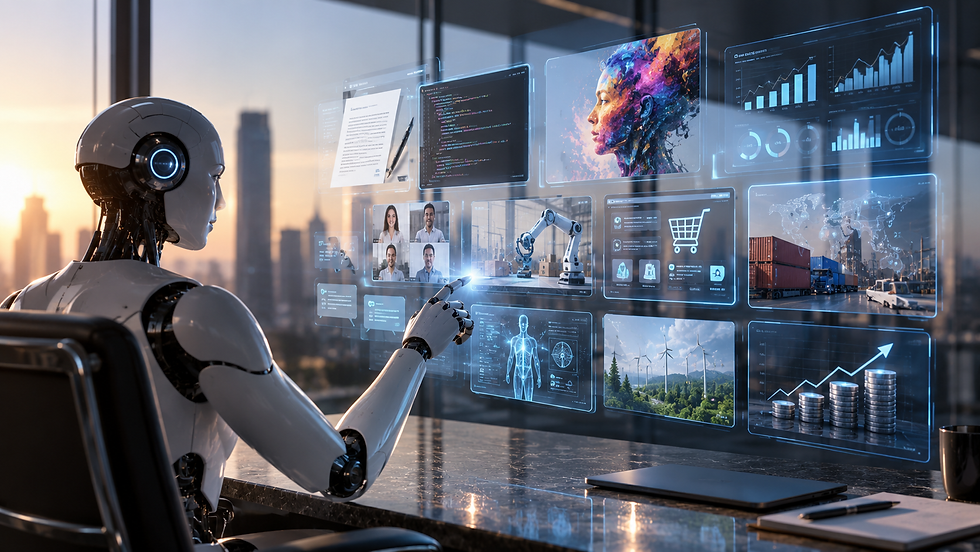
AI can read thousands of customer reviews. It can scan hundreds of competitors. It can examine patents. It can compare economic data. It can track new regulations. It can detect emerging behavioral signals on social media. It can generate alternative scenarios. It can challenge our assumptions. It can bring up options we haven't considered. This is a significant change. Because for the first time, the strategist's problem is not just reducing complexity , but understanding a larger part of that complexity.
AI's biggest contribution to strategy may not be providing answers.
I think one of the biggest mistakes companies will make is asking AI: “Design our strategy for us.”
I don't want that. Because strategy isn't just analysis. Strategy involves intention, courage, values – it's about who we are and who we want to be. It's about willingness to take risks – and most importantly, it requires choice. AI's greatest contribution to strategy might not be making choices for us, but expanding our range of choices .
The human mind often narrows down too quickly. We consider three alternatives. We decide two are unrealistic. We choose the third. And we call that a strategy. AI, however, can make us ask the question: "Why only these three alternatives?"
HBR's current strategy studies also point out that AI can be used to broaden the set of options in the strategic decision-making process, rather than narrowing them down early. This seemingly small change is actually a huge paradigm shift in strategy.
Therefore, my suggestion is not to add a fifth box to the SWOT analysis . We don't need more boxes. We need a more dynamic system. I designed this system and turned it into a book: AI-Powered Dynamic Strategy.
Indeed, strategy is supported by data, but it doesn't stem solely from data. It's an expression of the future we believe in and the future we're willing to risk our resources for. Therefore, AI's role shouldn't be to think for the board, but to force the board to think better .
It's time to separate planning from strategy again.
Here, it's necessary to reiterate the distinction I've been making for years:
Planning organizes the chosen future.
Strategy chooses which future we will pursue.
And today I'm adding a third sentence to that:
AI-powered dynamic strategy makes this selection continuously smarter.
This distinction is important.
Because most companies still do planning under the guise of strategy. Budgets, goals, projects, KPIs, roadmaps...
All of these are necessary. But only after we decide which future we want.
I propose a single question to the boards of directors.
Conduct a SWOT analysis at your next strategy meeting. But don't end the meeting after the SWOT analysis is complete. Put this question on the table:
“Based on these four boxes, what three truly different futures are possible for the next five years?”
Then the problem arises:
"In which of these futures do we want to win?"
Behind:
"What signals will we constantly monitor to indicate whether this is happening or not?"
And finally:
“Six months from now, which of our current strategic assumptions might we find to be wrong?”
That's when SWOT ceases to be just a box-filling exercise and becomes the beginning of strategic thinking.
Final words
SWOT is not dead.
Porter is not dead.
Scenario Planning is not dead.
None of the classic tools of strategy have to be discarded.
But we have to acknowledge that the world in which they emerged has changed.
Yesterday, the problem with the strategy was a lack of information.
Information overload today.
Yesterday, the manager's problem was his inability to come up with alternatives.
Today, it's about choosing what makes sense among thousands of alternatives.
Yesterday, strategy could have been a process that took place once a year.
Today, we need a constantly learning system.
Therefore, in my opinion, the strategy of the future will not involve more boxes.
It will include more signals, more scenarios, clearer choices, and much faster learning cycles.
SWOT analysis can still tell us where we stand. But it's no longer sufficient.
Because the real strategic question is this:
"As the world changes, what future are we choosing?"
And perhaps the real opportunity that AI brings to strategy lies here:
It's not about choosing the future for us; it's about enabling us to see more of the future before making a choice.


Comments